
Porta Palatina
- monument
- Price: Free
- Opening hours: Open 24 hours (exterior view)
Book a guided tour of Torino
Skip the line and see Torino with a local guide.
History
Built in the 1st century BC as the northern gate of Augusta Taurinorum, the Roman colony that grew into modern Turin, Porta Palatina is one of the most completely preserved city gates anywhere in the former Roman world. Its brick facade is framed by two sixteen-sided polygonal towers rising some 30 metres, flanking four arched passageways — two wider central ones for wheeled traffic and two narrower side openings for pedestrians — a layout that lays bare the practical, almost bureaucratic logic the Romans brought to urban planning.
Its survival is largely an accident of geography. Most Roman gates elsewhere in Italy were swallowed into medieval city walls, built over, or demolished as cities expanded and defensive needs changed, but Porta Palatina stood just outside the shrinking boundaries of medieval Turin and was left largely alone. Restoration in the 19th century stripped away later additions built onto the structure over the centuries, exposing the ancient brickwork that visitors see today.
Did you know?
Look closely at the two towers and you'll notice they don't quite match: one was left without battlements at the top, a deliberate choice by restorers who had no reliable evidence of the original crenellation, while the other was given a squared battlement typical of Roman military architecture. It's a small, honest admission built into the stonework — rather than guess and rebuild uniformly, restorers chose to show visitors exactly where verified history ends and reconstruction begins.
Porta Palatina is often compared to the Porta Nigra in Trier, Germany, the other great surviving Roman city gate north of the Alps, but Turin's version is arguably the more complete of the two, retaining both of its towers and all four of its original passageways. Just beside the gate, a stretch of original Roman paving is still visible, its stone slabs scored with the grooves worn by cart wheels two thousand years ago.
Good to know
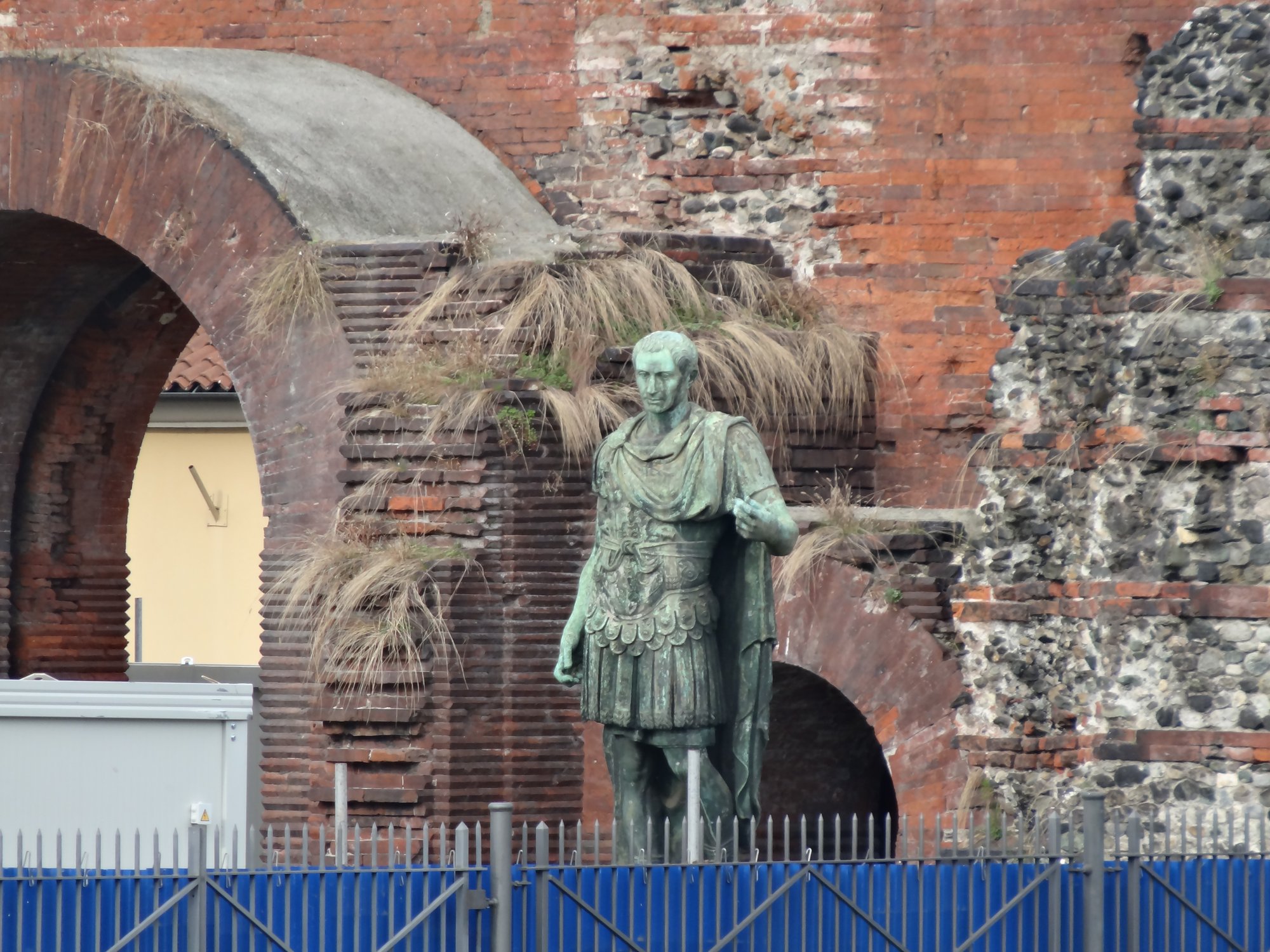
Porta Palatina is free to see at any time — there's no ticket, no gate, and no opening hours to plan around, since the structure and the small archaeological park around it sit open to the street. The best views are from the pedestrian park at its base, where bronze statues of Julius Caesar and Augustus, added in recent decades, let you walk right up to stonework that predates the city's medieval history by more than a thousand years.
The gate sits at the edge of Porta Palazzo, Europe's largest open-air market, and right beside the Quadrilatero Romano, so it combines naturally with a morning at the market stalls or an evening wandering the Quadrilatero's bars — no need to set aside separate time for it.