
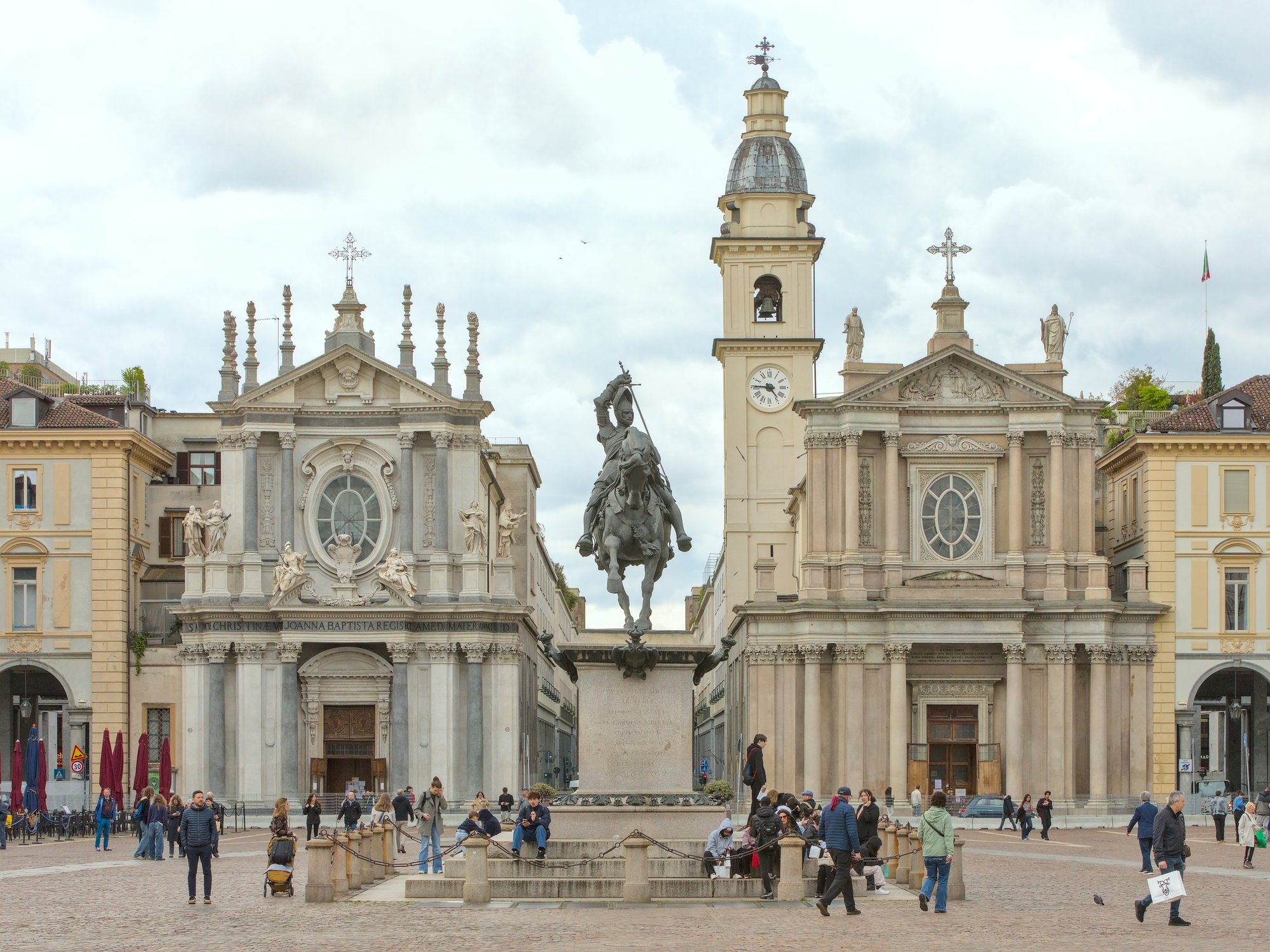
Piazza San Carlo
- piazza
- Price: Free
- Opening hours: Open 24 hours
Book a guided tour of Torino
Skip the line and see Torino with a local guide.
History
Piazza San Carlo was laid out from 1637 as part of Turin's planned Baroque expansion, designed by architect Carlo di Castellamonte as a rectangular square framed on all sides by uniform, continuous porticoes — an exercise in geometric order that became a model for the rest of the city's grid.
At its centre stands a bronze equestrian statue of Duke Emanuele Filiberto sheathing his sword, unveiled in 1838 to commemorate his decisive victory at the Battle of St Quentin in 1557, a win that helped restore Savoy's independence and territory. The square is closed off at its southern end by two churches, Santa Cristina and San Carlo Borromeo, whose matching facades give the piazza its celebrated symmetry.
Did you know?
Those two churches look like a genuine pair, but they aren't twins by birth: San Carlo Borromeo went up first, in 1619, while Santa Cristina dates to 1639. It was only decades later, between 1715 and 1718, that architect Filippo Juvarra gave Santa Cristina its ornate matching facade — engineering the illusion of symmetry that visitors admire today long after both buildings already stood.
The porticoes shelter some of Turin's most storied historic cafés, including Caffè San Carlo and Caffè Torino. Set into the pavement outside Caffè Torino is a bronze bull mosaic, the animal that gives Turin its name and symbol — local tradition holds that spinning on it with your heel brings good luck, and generations of Torinesi still do it in passing.
Good to know
Long nicknamed "il salotto di Torino" — the city's living room — the square regularly hosts markets, open-air concerts, and the city's Christmas illuminations, so its character shifts noticeably depending on the season and time of day.
It's also simply the best place in Turin for a classic café stop: the historic cafés under the porticoes still serve the aperitivo and vermouth traditions the city helped invent, and the covered walkways make the square a comfortable place to linger even in the rain.