
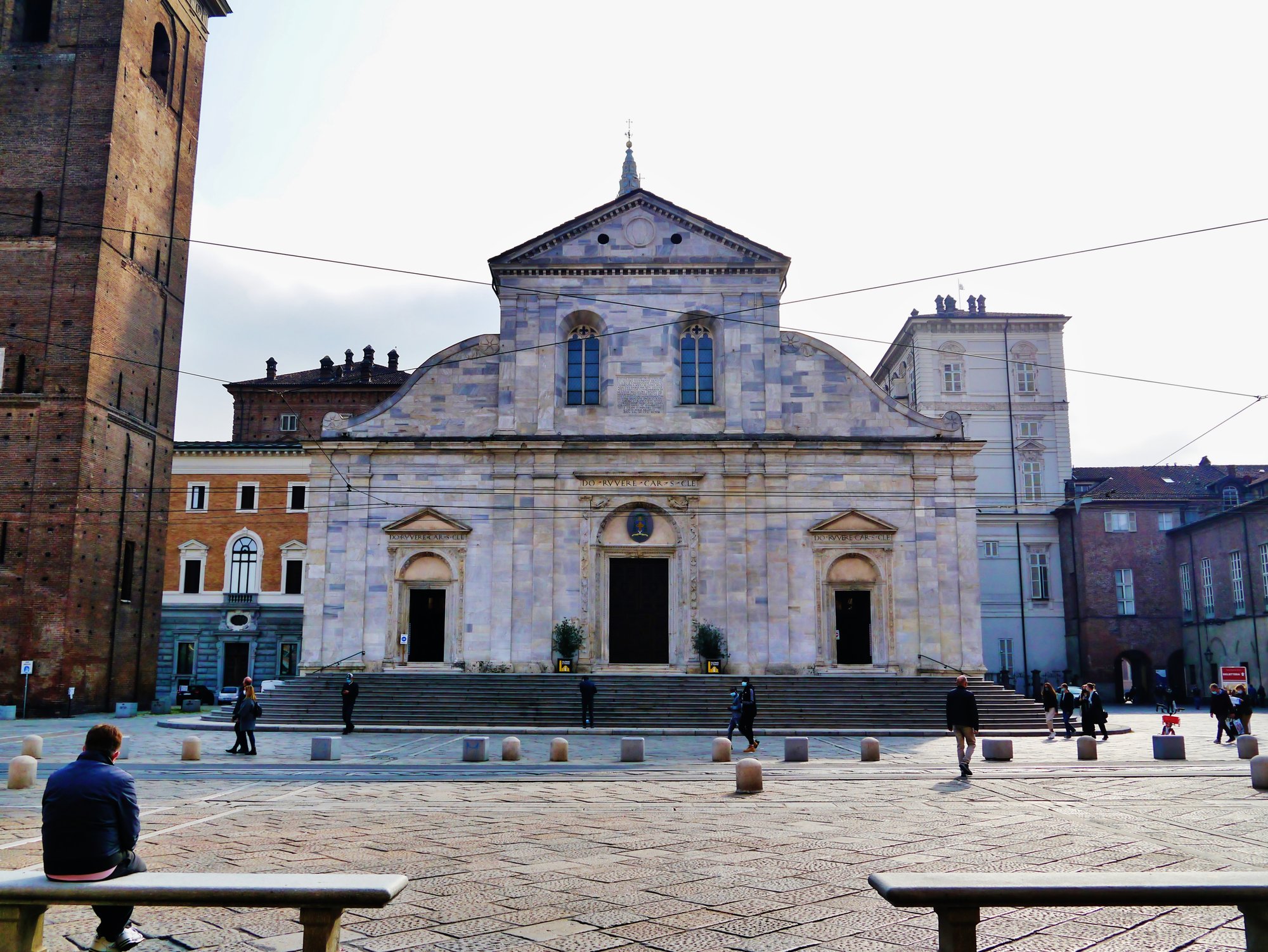
Turin Cathedral & the Holy Shroud
- sacred
- Price: Free (Shroud Museum €8)
- Opening hours: 07:00 - 12:30, 15:00 - 19:00 daily
History
Finished in 1498, the Cathedral of St John the Baptist is something of an anomaly in Turin: a white marble Renaissance building in a city whose skyline was later reshaped almost entirely in Baroque. It rose on the site of three earlier churches, and its comparatively restrained, harmonious facade still stands out against the more theatrical architecture the House of Savoy commissioned around it in the centuries that followed.
The cathedral's fame, though, rests less on its own architecture than on what's kept behind it. In 1694, architect Guarino Guarini completed a black-marble chapel connecting the cathedral directly to the Royal Palace, purpose-built to house the Shroud of Turin — a linen cloth brought to the city by the House of Savoy in 1578 and long venerated as the burial cloth of Christ. A catastrophic fire gutted Guarini's dome during restoration work in 1997; firefighters famously smashed through bulletproof glass to save the Shroud itself, and it took over two decades of careful reconstruction before the chapel reopened to the public in 2018.
Did you know?
The Shroud bears the faint image of a man's body, front and back, and for centuries it was widely accepted as the actual burial cloth of Jesus. That certainty has since given way to genuine, ongoing scientific and historical debate: a 1988 radiocarbon dating study placed the cloth's origin in the medieval period, a conclusion some researchers have since disputed on methodological grounds, while others point to details of the image and the weave they argue are hard to explain as a deliberate medieval forgery. No consensus exists, and the Church itself has never formally pronounced on the Shroud's authenticity, treating it instead as an object of devotion regardless of its literal origin.
Because of that unresolved status, and because textiles this old are extraordinarily fragile, the Shroud is not kept on permanent display. It's shown to the public only during rare, specially organized expositions, sometimes years apart, and the rest of the time it rests in a sealed, climate-controlled case inside the chapel, out of view.
Good to know
Visitors on an ordinary day will see the chapel and cathedral, not the cloth itself — the Shroud only comes out during scheduled expositions, so don't plan a visit around seeing it unless one has been officially announced. What's on view year-round is a full-scale photographic reproduction, along with Guarini's striking black-marble architecture.
Entry to the cathedral is free; the adjoining Museum of the Shroud, a separate attraction a short walk away, charges its own admission and goes into the object's full, contested history in far more depth than the chapel itself does.