
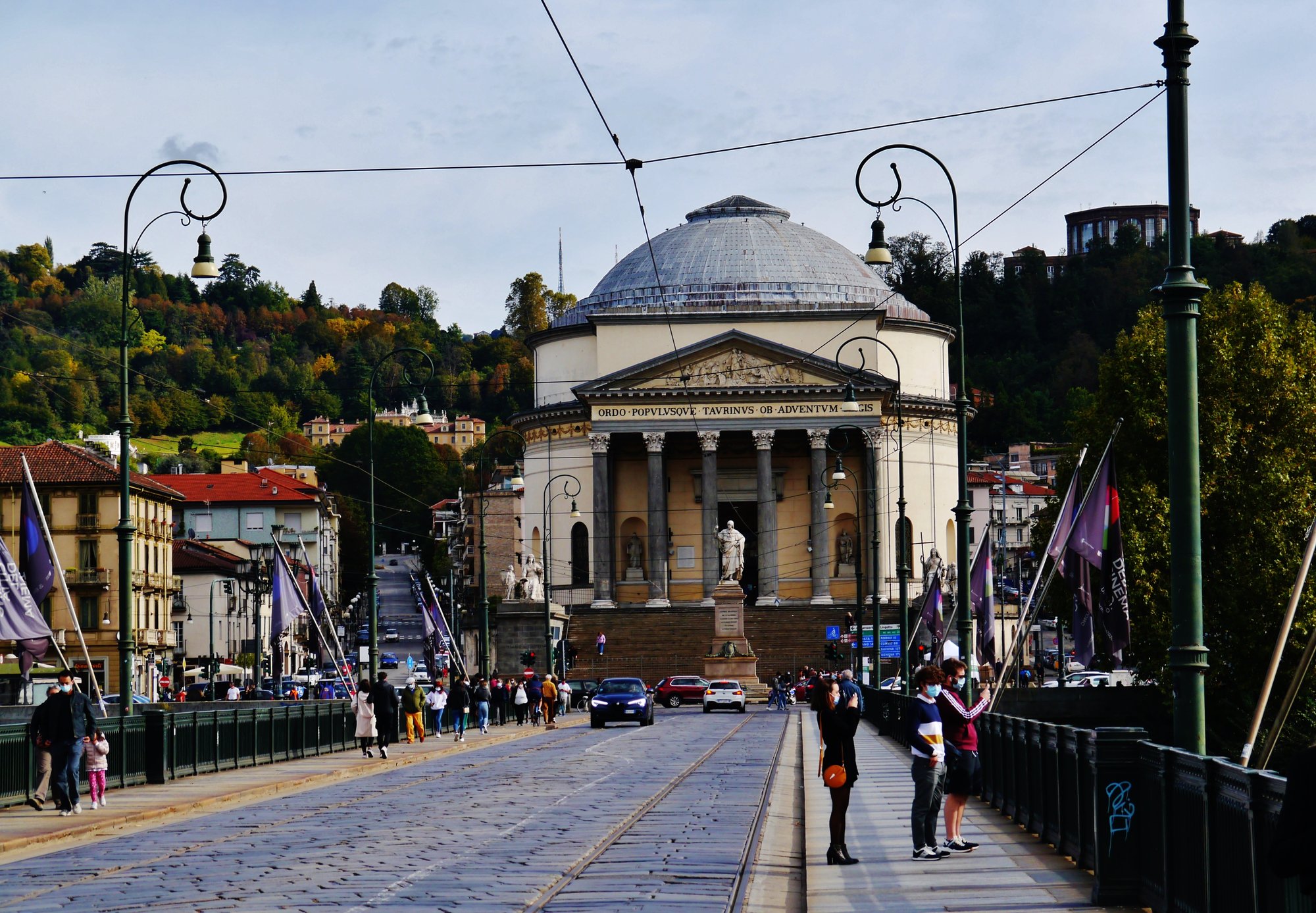
Chiesa della Gran Madre di Dio
- sacred
- Price: Free
- Opening hours: 08:00 - 12:30, 15:30 - 19:00 daily
Book a guided tour of Torino
Skip the line and see Torino with a local guide.
History
The city of Turin commissioned the Gran Madre di Dio in 1818 for an unambiguously political purpose: celebrating the return of King Vittorio Emanuele I to the throne after the fall of Napoleon ended years of French occupation. Rather than build a conventional Baroque church in the style that dominates the rest of the city, the architects reached back to Rome's Pantheon, giving the new church the same circular plan, dome and classical portico — a deliberate visual argument that the restored monarchy meant a return to timeless, stable order after decades of upheaval.
The site itself was chosen with equal deliberation. The church stands directly across the Po from Piazza Vittorio Veneto, closing the long, dead-straight sightline that runs down Via Po from the heart of the city — so the Gran Madre isn't just a building to visit, it's the visual full stop to one of Turin's grandest urban set-pieces, engineered to be seen and framed from a great distance rather than stumbled upon.
Did you know?
Two allegorical statues flank the church's monumental staircase, officially representing Faith and Religion. One of them was carved with such unusually lifelike, individual features that Turinese legend has long insisted she's hiding something at her feet — namely the Holy Grail, supposedly smuggled into the city and buried beneath her. The story has no historical basis whatsoever, but it fits neatly into Turin's enduring reputation, alongside genuine esoteric walking trails through the city, as a place fascinated with hidden magic and secret history.
The church's name — Gran Madre di Dio, the Great Mother of God — is a straightforward Marian dedication, but that hasn't stopped the same esoteric imagination from reading the building as a monument to a much older, pre-Christian mother goddess, folded into Turin's wider mythology as a city balanced between "white" and "black" magic.
Good to know
Entry is free and the church is open daily, with a midday closure typical of Italian churches — plan around the morning or late-afternoon hours rather than lunchtime.
The building is designed to be appreciated from a distance as much as up close: cross to the opposite bank and walk along Via Po, or pause partway across the Vittorio Emanuele I bridge, to see the church exactly as its 19th-century planners intended, closing the view down the street. The riverside promenade below and the short climb up to Monte dei Cappuccini for a panoramic view over the city both combine easily with a visit.