
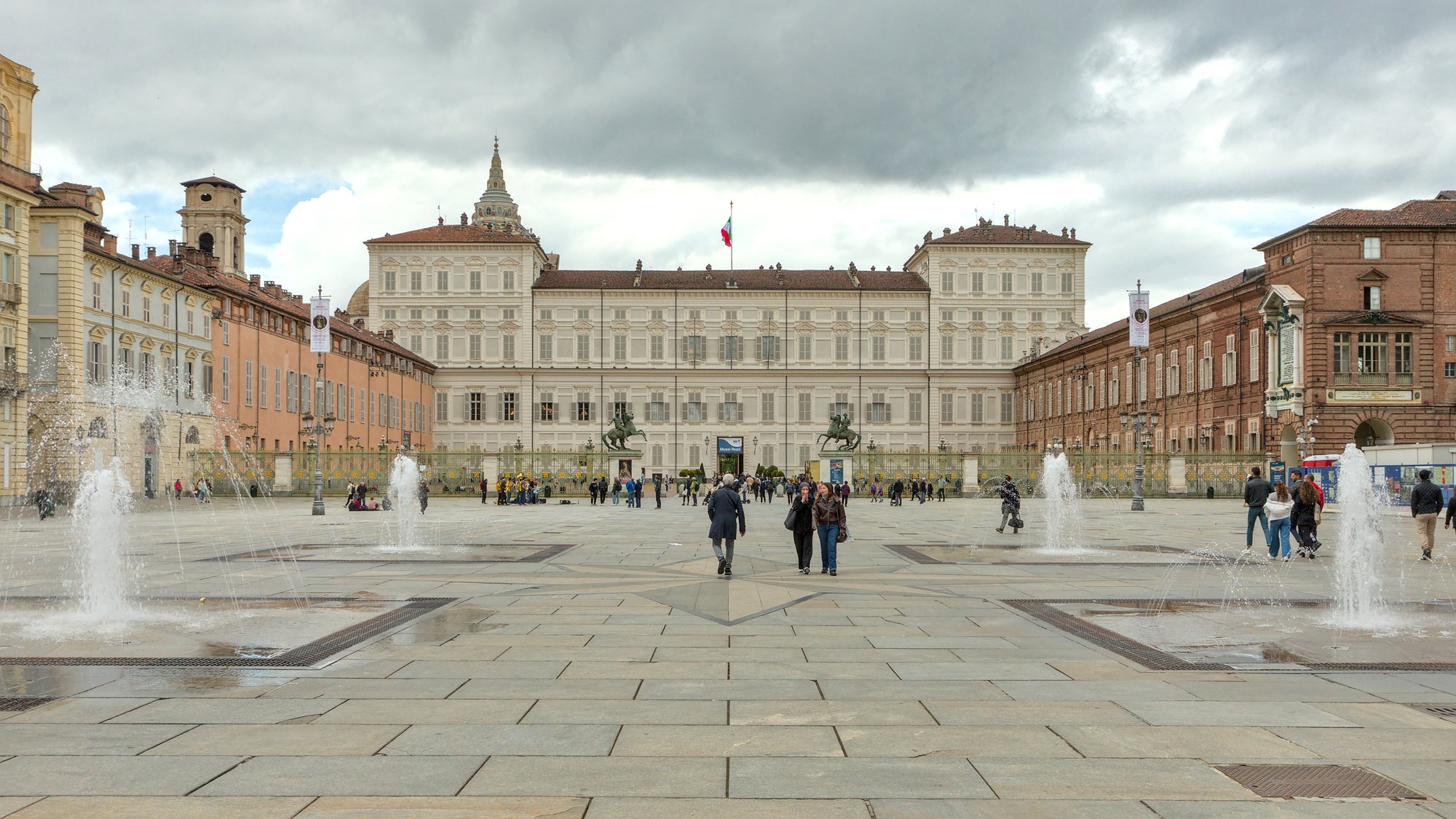
Royal Palace of Turin
- palace
- Price: €15 - €22
- Opening hours: Tue-Sun 09:00 - 19:00; closed Mon
History
Construction on the Royal Palace began in 1646 as the House of Savoy consolidated Turin as its seat of power, and the palace served as the family's official residence for well over two centuries, right up until Italian unification shifted the capital away from the city in 1865. Through that whole span it stood at the political heart of the Savoy state, expanded and refitted by successive dukes and kings as their ambitions grew.
The exterior gives almost nothing away: a long, plain facade in grey stone, deliberately restrained compared with the flamboyant Baroque going up elsewhere in the city. Behind it, the state rooms unfold in gilded excess — the Throne Room, a Chinese Cabinet lined with lacquered panels, and the Scissor Staircase, which the architect Filippo Juvarra carved in the 1720s with two flights that rise in a sweeping crossing pattern without ever physically touching. The Royal Armoury holds one of Europe's finest collections of arms and armour, and the Royal Library preserves Leonardo da Vinci's celebrated red-chalk self-portrait. The palace, its gardens and the ceremonial squares around it were jointly inscribed on the UNESCO World Heritage list in 1997, as part of the Residences of the Royal House of Savoy.
Did you know?
The contrast between the palace's severe exterior and its opulent interior wasn't an accident of budget — it reflects how Savoy power was meant to be experienced. The plain facade addressed the city and the wider public with restraint and control, while the full display of wealth and taste was reserved for those actually admitted inside, whether courtiers, diplomats or favoured guests.
Juvarra's Scissor Staircase is as much an engineering feat as a decorative one: its two flights climb along the same stairwell in a mirrored sweep, crossing paths visually while never touching structurally, a piece of stonework that still draws architects and engineers to study how it holds together. Upstairs, the Royal Library's Leonardo self-portrait is one of only a handful of surviving portraits believed to be drawn by the artist himself, and its fragile red chalk means it's shown only rarely and under carefully controlled light.
Good to know
The Royal Palace is closed on Mondays, and its central location on Piazza Castello makes it easy to combine with a visit to the neighbouring Palazzo Madama and a walk around the square itself. Budget more time than you might expect — between the state apartments, the Armoury and the Library, there's a lot of ground to cover.
Because the Leonardo self-portrait is shown only intermittently for conservation reasons, check ahead if seeing it specifically is a priority for your visit, rather than assuming it will be on display.