
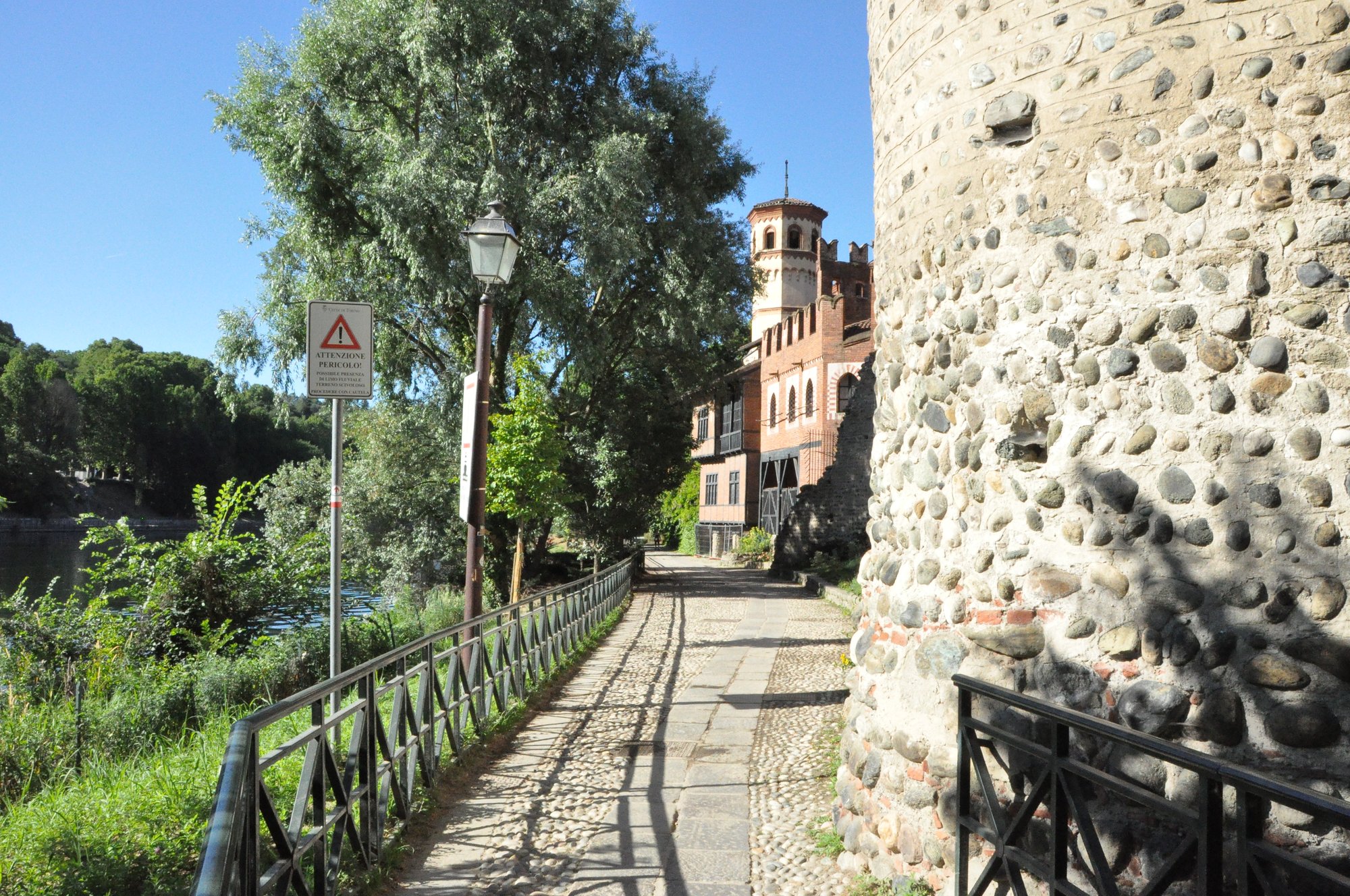
Borgo Medievale
- museum
- old-town
- Price: €5 - €7 (fortress)
- Opening hours: Grounds 09:00 - 20:00 daily; fortress Tue-Sun 09:00 - 19:00
Book a guided tour of Torino
Skip the line and see Torino with a local guide.
History
Turin built the Borgo not as a piece of exhibition scenery but as a genuine work of historical scholarship. When the city hosted the 1884 Italian General Exposition, architects and historians fanned out across Piedmont and the Aosta Valley, measuring and sketching real houses, workshops, doorways and decorative details from villages and castles, some of them already crumbling. What they assembled inside Parco del Valentino is a composite village — no single place matches it exactly — but every wall, balcony and carved beam was copied from something that had actually stood somewhere in the region. At its heart rises the Rocca, a fortified manor modeled on the alpine castles of the Aosta Valley, its rooms filled with carefully reconstructed period furniture, tapestries and arms.
The Borgo was meant to be dismantled once the exposition closed, like the rest of the temporary fairground around it, but Turinese visitors grew so attached to it that the city decided to keep it standing for good — a rare case of a 19th-century "temporary exhibit" outliving the fair that built it by well over a century. Along its cobbled lanes, artisan workshops still turn out ceramics, woven textiles and forged ironwork much as they might have in the medieval village the Borgo imagines. A multi-year, multi-million-euro restoration of the whole complex has recently wrapped up, reopening houses and the historic Café San Giorgio to visitors.
Did you know?
Because the Borgo was assembled from real architectural fragments and faithful copies rather than invented from scratch, historians still treat it as a legitimate reference for everyday Piedmontese building traditions of the 15th century — a "reconstruction" taken seriously enough to be studied, not just visited.
The Rocca's garden is its own small act of historical reconstruction: it was replanted according to what botanists and historians could establish about a genuine 15th-century Piedmontese garden, right down to the species chosen, rather than laid out as generic period-style landscaping.
Good to know
The village lanes and workshop streets are free to wander at any time during opening hours; only the Rocca, the fortified manor at the Borgo's center, requires a paid ticket to visit its furnished rooms.
The Borgo sits inside Parco del Valentino, right on the Po, so it combines naturally with a riverside walk or a stop at the park's botanical garden — allow a little extra time if you want to see both.